

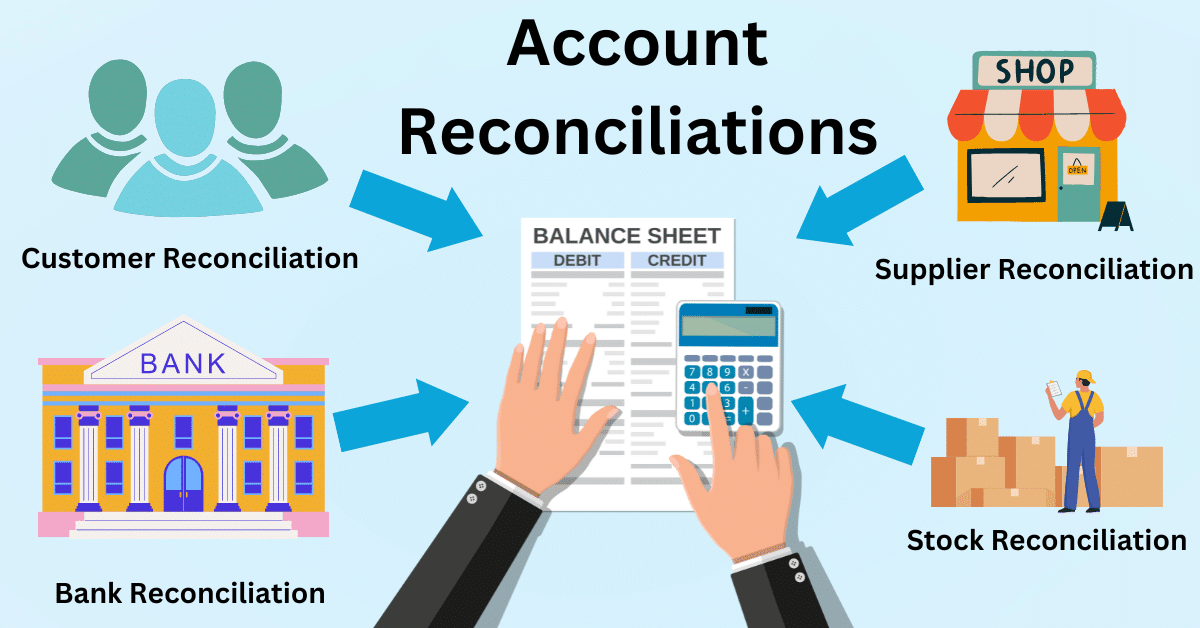
What is reconciliation in accounting? It is the process of comparing two sets of records to ensure they agree and are accurate. If there are differences, reconciliation identifies them, explains them, and ensures any errors are corrected. It’s a fundamental internal control that prevents errors, catches fraud, and ensures that the financial statements used by investors and management are reliable.
The most familiar example is bank reconciliation – comparing your cash records to the bank statement. But reconciliation happens across many accounts and processes.
Types of Accounting Reconciliation
| Type | What It Compares | Frequency |
|---|---|---|
| Bank reconciliation | Internal cash book vs bank statement | Monthly |
| Accounts receivable reconciliation | AR subledger vs general ledger | Monthly |
| Accounts payable reconciliation | AP subledger vs general ledger | Monthly |
| Intercompany reconciliation | Transactions between related entities | Monthly/quarterly |
| Balance sheet reconciliation | Account balances vs supporting documentation | Monthly/quarterly |
| Credit card reconciliation | Credit card statements vs expense records | Monthly |
| Inventory reconciliation | Physical count vs inventory records | Monthly/quarterly/annually |
| Payroll reconciliation | Payroll records vs GL entries vs tax filings | Each pay period |
The General Reconciliation Process
Step 1: Obtain both sets of records
Get the internal record (general ledger, subledger) and the external or reference record (bank statement, vendor statement, etc.)
Step 2: Match transactions
Go through each transaction and match it between both records.
Step 3: Identify discrepancies
Flag any items that appear in one record but not the other, or that appear with different amounts.
Step 4: Investigate differences
Determine whether the difference is:
- Timing (transaction recorded in one system but not yet processed in the other)
- Error (wrong amount, duplicate entry, missed transaction)
- Fraud (unauthorized transaction)
Step 5: Make corrections
Adjust the incorrect record with appropriate journal entries.
Step 6: Document and sign off
Reconciliations should be reviewed and approved by someone other than the preparer – this is the internal control element.
Why Reconciliation Matters
| Benefit | What It Prevents |
|---|---|
| Accuracy | Financial statements containing errors |
| Fraud detection | Unauthorized transactions going unnoticed |
| Audit readiness | External auditors will test key reconciliations |
| Regulatory compliance | SOX and other frameworks require documented reconciliations |
| Decision quality | Management decisions based on incorrect data |
Unreconciled accounts are one of the most common audit findings – and one of the most preventable.
Reconciliation in the Context of Sarbanes-Oxley (SOX)
For publicly traded US companies, SOX Section 404 requires documented evidence of internal controls over financial reporting – which includes regular, reviewed account reconciliations. External auditors test these controls as part of the annual audit. Gaps in reconciliation can result in material weaknesses – a serious finding for any public company.
Common Reconciliation Errors
| Error Type | Example |
|---|---|
| Timing difference | Check issued in December cleared in January |
| Transposition error | $1,350 recorded as $1,530 |
| Duplicate entry | Invoice posted twice |
| Omitted transaction | Bank fee not recorded in books |
| Wrong account | Expense coded to wrong GL account |
The Bottom Line
Reconciliation in accounting is the process that ensures your financial records are complete, accurate, and agree with supporting documentation. It’s not glamorous work – but it’s the foundation of trustworthy financial reporting. Organizations that do it consistently and rigorously catch errors early, deter fraud, and build the kind of financial infrastructure that scales.
