

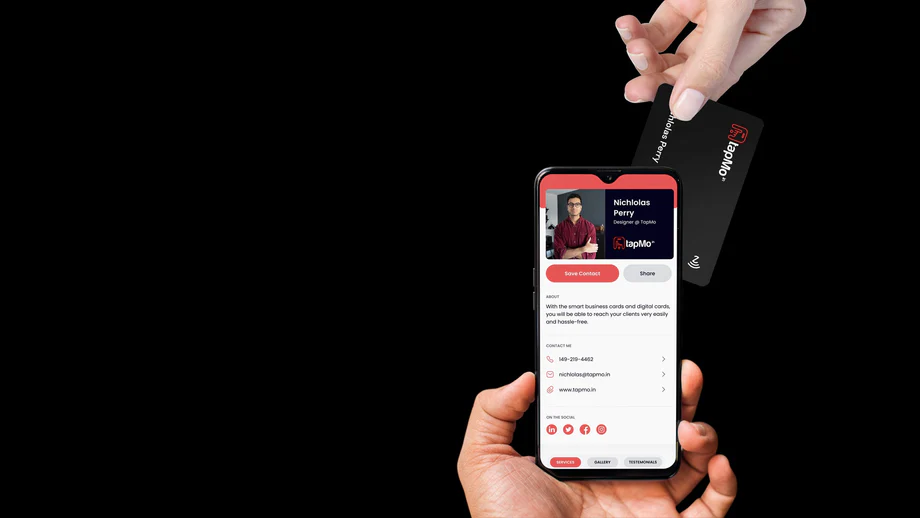
A tap business card solves one of the biggest problems with traditional paper cards: most people never save them. Think about how many paper business cards you have handed out in the last year. Now think about how many of those actually got saved. For most people, the honest answer is not many.
A tap business card solves that problem. One tap transfers your information directly to the other person’s phone – where it lives in their contacts, not at the bottom of a desk drawer. It’s a small shift, but for anyone who networks regularly, it genuinely changes how introductions work.
How Does It Actually Work?
Tap business cards use NFC (Near Field Communication) – the same technology behind Apple Pay and Google Pay. Inside the card is a tiny chip and antenna. When you tap it against the back of a smartphone, the phone reads the chip and opens a digital profile page in the browser – no app download required.
You control what that profile shows: your name, job title, phone number, email, LinkedIn, Instagram, website, portfolio, payment links – basically anything with a URL. Most tap card providers give you a dashboard to update this information at any time, so your card never goes out of date.
Tap Business Card vs. Paper Business Card
| Factor | Tap Business Card | Paper Business Card |
|---|---|---|
| Cost | £15-£60 one-time | £20-£100 per 500 cards (reprinted when info changes) |
| Information capacity | Unlimited (links to full profile) | Limited to card size |
| Updateability | Edit anytime from your phone | Reprint required for any change |
| Environmental impact | One card, used indefinitely | Thousands of cards, mostly discarded |
| Requires receiver to have app? | No – works in any browser | No – but easily lost or ignored |
| Works without internet? | No (profile loads online) | Yes |
| Impression on recipient | Modern, memorable | Standard, expected |
Top Tap Business Card Brands (2025)
| Brand | Price Range | Best For | Standout Feature |
|---|---|---|---|
| Popl | 0-0 | Professionals & salespeople | Largest user community, app integrations |
| HiHello | -0/year | Teams and businesses | Team management dashboard |
| Mobilo | 0-0 | Corporate teams | CRM integration (Salesforce, HubSpot) |
| Linq | 8-5 | Creators & freelancers | Clean profile page design |
| Blinq | Free-0/month | Budget-conscious users | Free tier available |
Who Should Use a Tap Business Card?
They are not for everyone – but for certain professions, they are close to a no-brainer:
Sales professionals who meet new contacts daily and want every touchpoint to be frictionless.
Freelancers and creatives who need to share portfolios quickly without fumbling with URLs.
Executives and consultants where the modern, tech-forward impression matters.
Event networkers at conferences, trade shows, and meetups where fast exchanges are the norm.
If you hand out fewer than 10 business cards a year, a paper card probably still works fine.
What Information Can You Put On It?
Most platforms let you add: full name and title, company and logo, phone numbers and email addresses, LinkedIn, Twitter, Instagram, website or portfolio, Calendly or booking link, PayPal or Venmo payment links, and a short bio or tagline.
Some platforms also support file downloads such as PDFs and lookbooks, and video embeds – useful for creative professionals or hospitality businesses.
Things to Consider Before Buying
Platform lock-in: Your profile lives on the provider’s servers. If they shut down or you stop paying, your card stops working. Check what export options exist.
NFC compatibility: All modern iPhones (XR and later) and Android phones support NFC tap. Older devices may need to scan a QR code on the back instead – most tap cards include this as a backup.
Card material: Most are PVC like a credit card, but metal and bamboo options exist. Metal looks premium but costs more and can interfere with NFC on some phone cases.
Team vs. individual plans: If you need cards for a whole team, look for platforms with team dashboards and bulk pricing – Mobilo and HiHello are strongest here.
Are They Worth It?
For most professionals who network regularly: yes. A one-time cost of £20-£50 for a card you never have to reprint, that always has your current information, and that makes a stronger impression than a paper card – it is hard to argue against.
The real value is not the technology. It is that the other person actually has your details saved on their phone by the time you have finished shaking hands.
